






Puerto Rico
From Wikitravel
Contents
|
|
| Location | |
|
|
| Flag | |

|
|
| Quick Facts | |
| Capital | San Juan |
| Government | Commonwealth |
| Currency | US dollar (USD) |
| Area | 9,104 km2 |
| Population | 3,957,988 (July 2002 est.) |
| Language | Spanish, English |
| Religion | Roman Catholic 85%, Protestant and other 15% |
| Electricity | 120V/60Hz (North American plug) |
| Calling Code | +1 787 and +1 939 |
| Internet TLD | .pr |
| Time Zone | UTC -4 |
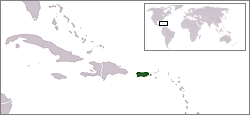
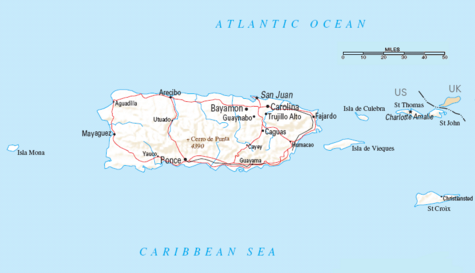
Puerto Rico [1] is a Caribbean island that is a self governing commonwealth of the United States of America. Located in the Caribbean Sea to the east of the Dominican Republic and west of the U.S. Virgin Islands, Puerto Rico lies on a key shipping lane to the Panama Canal, the Mona Passage.
Regions
- Puerto Rico - the main island itself
- Culebra
- Vieques, also known as Isla Nena or Little Girl Island, is a small, rural island approximately 18 miles East of Puerto Rico.
- La Isla Mona- Mona Island, off of the west coast of PR, half way to the Dominican Republic, this island is a secluded island only inhabited by widlife. You can only go to the island by appointment.
Municipalities

- San Juan - the capital - has one of the biggest and best natural harbors in the Caribbean
- Aguadilla
- Arecibo - home of the world's largest radio telescope
- Caguas
- Camuy
- Carolina
- Fajardo
- Guayama
- Luquillo - best public beach, reef protected swimming area with views of El Yunque. Rainforest
- Mayaguez
- Moca
- Ponce
- Rincón
- Salinas
- Cabo Rojo
Other destinations
- El Yunque National Forest
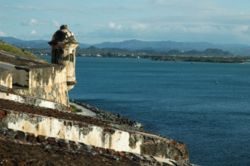
- San Juan National Historic Site - includes forts San Cristóbal, San Felipe del Morro, and San Juan de la Cruz, also called El Cañuelo, plus bastions, powder houses, and three fourths of the city wall. All these defensive fortifications surround the old, colonial portion of San Juan, Puerto Rico
- La Parguera- Bioluminescent Bay in Lajas
- Mosquito Bay- Bioluminescent Bay on Vieques Island
- Arecibo Observatory- Largest Radio Telescope in the World
- Camy Caves- Las Cavernas del Rio Camuy- 3rd largest cave system in the world
- Bacardi House- La Casa Bacardi- Bacardi Rum Distillery
- Vieques Island
- Culebra Islnd
Understand
Climate
Puerto Rico has a tropical marine climate, which is mild and has little seasonal temperature variation. Temperatures range from 70˚F to 90˚F (21˚C to 32˚C), and tend to be lower at night and up in the mountains. The average annual temperature is 26°C (80°F). Hurricane season spans between June and November. Periodic droughts sometimes affect the island.
Terrain
Puerto Rico is mostly mountainous, although there is a coastal plain belt in the north. The mountains precipitous to the sea on the west coast. There are sandy beaches along most of the coast. There are many small rivers about the island and the high central mountains ensure the land is well watered, although the south coast is relatively dry. There is a fertile coastal plain belt in north. Puerto Rico's highest point is at Cerro de Punta, which is 1,338 m above sea level.
Get in
Since Puerto Rico is a US territory US citizens do not need a passport to travel to Puerto Rico from the US or vice versa. A driver's license should suffice.
By plane
Puerto Rico's main airport is Luis Muñoz Marín International Airport (IATA: SJU) in San Juan. Jet Blue, Continental and Delta Connection also fly to smaller airports in the cities of Aguadilla and Ponce.
As Puerto Rico is part of the US commonwealth, U.S. Immigration and Customs Laws and Regulations apply, however, U.S. citizens flying back to the U.S. mainland from Puerto Rico will not have to pass through Customs before boarding their flight. Travel [2] between the mainland and San Juan, Ponce and Aguadilla is the same as if it were between two mainland cities.
Most U.S. and many international airlines offer direct flights from many cities to Puerto Rico. Flights are economical and numerous. SJU is the biggest and most modern airport in the Caribbean and offers all the conveniences and services (McDonalds, Dominos, Starbucks, etc.) of a major city airport. American Eagle operates a hub at SJU and airlines like Caribbean Sun, Liat and Cape Air offer cheap and easy connections to most Caribbean islands.
If you have lots of luggage, beware there are no baggage carts in the domestic terminal, although there are plenty of baggage porters available to help you for a tip or fee. Luggage Carts are available in the international terminal of the airport. At the exit, a porter will assist you with your luggage for a fee.
Transferring from the airport to your hotel usually requires taking a taxi, although some hotels provide complimentary transportation to their properties in special buses. Puerto Rico Tourism Company representatives at the airport will assist you in finding the right transportation. All major car rental agencies are located at the airport, and others offer free transportation to their off-airport sites.
Typical flight times (outbound flights are slightly longer due to headwinds):
- Chicago 5 hours
- Los Angeles 7.5 hours
- Madrid 7 ¾ hours
- New York 4 hours
- Atlanta 3.5 hours
- Toronto 4 ¼ hours
- Miami 2.5 hours
On your way back out of Puerto Rico, note that you'll be required to pass all your check-in bags through a US Dept of Agriculture inspection before checking in. Many agricultural products, including most fruits and vegetables, are in fact permitted [3], but will be checked for disease. Cruise ship passengers with ship luggage tags are exempted.
By boat
A commercial ferry service connects the west coast city of Mayaguez and Santo Domingo in the Dominican Republic. This service is very popular and convenient way to travel between both cities. There is also a ferry from the city of Fajardo to St. Thomas, USVI. Also, more than a million passengers visit the island on cruise ships every year, whether on one of the many cruise lines whose homeport is San Juan, or on one of the visiting lines. No passport is required for U.S. citizens who use this service.
Get around
Public transportation in Puerto Rico is fairly bad: outside San Juan, there are no scheduled buses or trains. Most travelers choose to rent their own cars, but intrepid budget travelers can also explore the shared cab (público) system.
By car
If you are planning to explore outside of San Juan, renting a car is by far the most convenient way to get around. Rentals are available from the airport as well as larger hotels.
Parking in the Old Town of San Juan is virtually non-existent (there is a public parking lot called "La Puntilla" which on weekends you only pay a fixed rate for the whole day, and it always has parkings available) and traffic in all major cities is bad during rush hour (8-10am, 4-6pm), so give yourself plenty of time coming and going.
Road signs are Spanish language versions of their U.S. counterparts, so you shouldn't have trouble figuring them out. However, note that distances are in kilometers, while speed limits are in miles. Gas is also sold by the liter, not by the gallon, but prices are roughly equivalent to the continental US.
In additional to the regular free highway (carretera) network, there are three toll roads (autopista) on Puerto Rico. They're much faster and less congested than the highways, and it's worth using them if in any kind of hurry. Tolls for a 2-axle car range from $0.70 and $1.50. The lanes on the left are reserved for people with RFID toll passes, which you probably won't have on your rental car. If you need change, head for the lanes marked with a "C", usually the furthest to the right.
Off the main highways, roads in Puerto Rico quickly become narrow, twisty and turny, especially up in the mountains. Roads that are only one-and-a-half lanes wide are common, so do like the locals do and beep before driving into blind curves. Signage is often minimal, although intersections do almost always show the road numbers, so a detailed highway map will come in handy.
Police cars are easy to spot, as by local regulation, they must keep their blue light bar continuously illuminated any time they are in motion. Avoid getting a speeding ticket: fines start at $50 + $5 for each mile above the speed limit.
By público
A público is a shared taxi service and is much cheaper than taking a taxi around the island, and depending on your travel aspirations, might be cheaper than renting a car. Públicos can be identified by their yellow license plates with the word "PUBLICO" written on top of the license plate. The "main" público station is in Río Piedras, a suburb of San Juan. They're also known as colectivos and pisicorres.
There are two ways of getting on a público. The easier way is to call the local público stand the day before and ask them to pick you up at an agreed time. (Your hotel or guesthouse can probably arrange this, and unlike you, they probably know which of the multitude of companies is going your way.) This is convenient, but it'll cost a few bucks extra and you'll be in for a wait as the car collects all the other departing passengers. The cheaper way is to just show up at the público terminal (or, in smaller towns, the town square) as early as you can (6-7 AM is normal) and wait for others to show up; as soon as enough have collected, which may take minutes or hours, you're off. Públicos taper off in the afternoon and stop running entirely before dark.
Públicos can make frequent stops to pick up or drop of passengers and may take a while to get to their destination terminal, but you can also request to be dropped off elsewhere if it's along the way or you pay a little extra. Prices vary depending on the size of the público and the distance being traveled. As an example, a small público that can seat three or four passengers from Ponce to San Juan will cost roughly $15, while a 15 passenger público that is traveling between San Juan and Fajardo will cost about $5 each person.
By ferry
Ferries depart from San Juan and Fajardo & the most popular arrivals are Cataño, Vieques Island & Culebra Island.
Do
Whether you're dreaming about spectacular surfing waves, a challenging golf course, or the perfect sunbathing beach, Puerto Rico offers the active traveler a tremendous array of opportunities. Surfing and golf compete with tennis, fishing, kayaking, scuba diving, and horseback riding, not to mention windsurfing and parasailing, for your active time. The island has over 15 championship golf courses a short drive away from the San Juan metropolitan area.
Learn about the different character of Puerto Rico's favorite beaches, or find out where to participate in your favorite sports. The hardest part will be choosing what to do first.
Blue Flag in Puerto Rico
The Blue Flag Program, initiated in Europe since 1987 has been modified for implementation in the Caribbean. It is voluntary program and it has proven along the years to be a very effective strategy to guarantee the best quality in beach services for bathers in different parts of the world.
Scuba dive
... Puerto Rico's Caribbean coasts. Spectacular wall diving offshore Guánica, or the cayos of the Spanish Virgin Islands of Culebra & Vieques. PADI 5 star Instruction.
El Yunque
El Yunque, Puerto Rico's rain forest is a must see. It spreads out over a mountain, so if you walk uphill from the road you're in a cool rain forest. At any altitude you'll see numerous varieties of plant and animal life. If you're lucky you can catch a glimpse of the endangered Puerto Rican parrot & hear the song of the local Coqui tree frog. There are tons of hiking trails and the Yokahu tower is a great spot to see the forest from above. There are also two trails that lead you straight down to La Mina waterfalls. You can swim at the bottom of the falls in the cold refreshing water.
Out Door Adventures
There is plenty to do outside the metropolitan areas. Many small family owned tour companies provide guided tours of the Central Mountains in Utuado near Río Tanama, Repelling in Arecibo, kayak tours of Lake Guajataka, and horse back riding on the beach in Aguadilla. Some of the tour operators also provide low cost or free lodging. Let's Go Puerto Rico has listed a few of these outfitters or you can simply do an internet search with the name of the area you would like to visit to find things to do. The individual towns also have yearly festivals listed in the tourism guides available at both major airports.
Talk
- See also: Spanish phrasebook
Both Spanish and English are the official languages of Puerto Rico, but Spanish is without a doubt the dominant language. Fewer than 20 percent of Puerto Ricans speak English fluently, according to the 1990 U.S. Census. Spanish is the mother tongue of all native Puerto Ricans, and any traffic signs and such are written exclusively in Spanish. However, people working in tourism-related businesses are usually fluent in English, usually locals in less touristed areas of the island can usually manage basic English, as it's taught as a foreign language in school. Menus in restaurants, even off the beaten track, are almost invariably bilingual.
That said, as anywhere, it's respectful to try make an effort and try to learn at least the basics. If you're already familiar with the language, beware that Puerto Rican Spanish speakers have a very distinct accent, and is often spoken at a relatively faster speed than Central American or Mexican Spanish. It is also full of local jargon and slang unfamiliar to many outside the island.
Buy
Puerto Rico is full of modern shopping malls and outlet centers. The most notable of which, Plaza las Americas, is currently the largest such shopping mall in the Caribbean and offers a wide array of stores, eating facilities and a large movie theater. Most major U.S. mainland and European retailers are located in the mall.
The Condado section of San Juan is home to fine designer stores such as Cartier, Gucci, Ferragamo, Mont Blanc and Dior.
You might want to check out the Belz Factory Outlets and the Prime Outlets of Puerto Rico. They house stores like Polo, Hilfiger, Banana Republic, Puma, Gap, PacSun, etc.
Most of the large cities on the island have a large regional mall with very familiar international stores.
There are plenty of ATM around the commonwealth. Most are linked to the Cirrus, Plus, American Express and Discover networks.
If you're looking for local crafts of all sorts, and want to pay less than in Old San Juan while getting to know the island, try going to town festivals. Artisans from around the island come to these festivals to sell their wares: from typical foods, candies, coffee and tobacco to clothing, accessories, paintings and home décor. Some of these festivals are better than others, though: be sure to ask for recommendations. One of the most popular (yet remote) festivals is the "Festival de las Chinas" or Orange Festival in Las Marías.
Duty free
One of the interesting facts about Puerto Rico that might not be emphasized enough in travel guidebooks is that since Puerto Rico is self governing due to its Commonwealth status, there are no federal taxes or import duties paid on on commodities like gasoline (about $0.75/liter for 87 octane in San Juan, as of May 2007) or rum.
This might be an important consideration when planning how much empty luggage to bring (allowance for U.S. customs is 5 liters per person), as a 750 ml bottle of Johnny Walker Blue Label costs only $12 in the duty-free airport shop vs. $20+ on the mainland. Bacardi liquor brands are very inexpensive as well -- paying $8.00 for a 750 ml bottle of Bombay Sapphire gin can be something of a shock, after paying $9.00 for a single 4 oz martini of the same booze at La Guardia only 4 hours earlier.
Eat
Puerto Rico is a drive-through buffet. All you need is a car, an appetite (the bigger the better), time, and the realization that your swimsuit won't fit as well when you get to your destination. The island has the most diverse culinary offerings in the entire Caribbean. There's something for everyone. You can enjoy the finest Puerto Rican food on most traditional town squares and also (for those of you who get homesick) have a steak at a place like Morton's.
Cuisine
 |
 |
 |
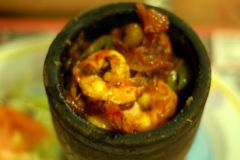
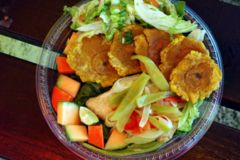
Mofongo con
camarones

|
Fish with plantain
fritters
 (tostones) and salad
 |
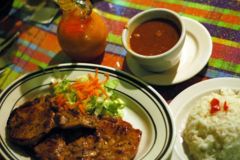
A typical Puerto Rican meal:
pork chops (chuletas), rice &
beans
 (arroz y habichuelas), a
bottle of sofrito and some
token greens to appease the tourists
(arroz y habichuelas), a
bottle of sofrito and some
token greens to appease the tourists |
Authentic Puerto Rican food (comida criolla) can be summed up in two words: plantains and pork, usually served up with rice and beans (arroz y habichuelas). It is rarely if ever spicy, and to many visitors' surprise has very little in common with Mexican cooking.
Plantains (plátanos) are essentially savory bananas and the primary source of starch back in the bad old days, although you will occasionally also encounter cassava (yuca) and other tropical tubers. Served with nearly every meal, incarnations include:
- mofongo — plantains mashed, fried, and mashed again, when filled up (relleno) with seafood this is probably the best-known Puerto Rican dish of them all
- tostones — twice deep-fried plantain chips, best when freshly made
- sopa de plátanos — mashed plantain soup, looks and tastes like baby food
The main meat eaten on Puerto Rico is pork (cerdo), with chicken a close second and beef and mutton way down the list. Seafood, surprisingly, is only a minor part of the traditional repertoire: the deep waters around Puerto Rico are poorly suited to fishing, and most of the seafood served in restaurants for tourists is in fact imported.
- chicharrones — crispy dry pork rinds, Puerto Rico's favorite snack
- chuletas — huge, juicy pork chops, available grilled or deep fried.
- lechón asado — roast suckling pig, this is the pinnacle of Puerto Rican porkcraft. Served at specialty restaurants, with the town of Cayey off the San Juan-Ponce highway being particularly famous.
- morcilla — blood sausage
- pernil de cerdo — ham shoulder with oregano and garlic
A few other puertorriqueño classics include:
- arroz con gandules — rice with pigeon peas, the unofficial national dish of Puerto Rico
- arroz con jueyes — rice with land crab meat
- asapao — a tomatoey spicy stew with rice and chicken or seafood
- bacalaitos — salted cod fritters
- chillo — red snapper, the most common fresh fish on the island
- empanadillas — fritters of cheese, meat or lobster
- sofrito — a fragrant sauce of sweet pepper, herbs, garlic and oil, used as base and seasoning for many dishes
- quenepas — a green grape-like fruit common in summer, don't eat the skin or seeds (and watch where you put them, they stain clothes easily)
Places to eat
Meals in sit-down restaurants tend to be fairly pricy and most touristy restaurants will happily charge $15-30 for mains. Restaurants geared for locals may not appear much cheaper, but the quality (and quantity) of food is usually considerably better. It's not uncommon for restaurants to charge tourists more than locals, so bring along a local friend if you can! Note that many, restaurants are closed on Mondays and Tuesday.
If you want to eat like a local, look for places that are out of the way. There is a roadside food stand or 10 at every corner when you get out of the cities. Deep-fried foods are the most common, but they serve everything from octopus salad to rum in a coconut. You might want to think twice and consult your stomach before choosing some items - but do be willing to try new things. Most of the roadside stand food is fantastic, and if you're not hung up with the need for a table, you might have dinner on a beach, chomping on all sorts of seafood fritters at $1 a pop, drinking rum from a coconut. At the end of dinner, you can see all the stars. In the southwest of the island, in Boqueron, you might find fresh oysters and clams for sale at 25 cents a pop.
If you are really lucky, you might get invited to a pork roast. It's not just food - it's a whole day - and it's cultural. Folks singing, drinking, hanging out telling stories, and checking to see if the pig is ready, and staying on topic, you'll find the pig likely paired with arroz con gandules (rice with pigeon peas).
With all these choices - roadside stands, local hangouts that you just might find - things that you've never seen before - do yourself a flavor and never eat from the commercial fast food restaurant except maybe, the fried chicken restaurants, which just do it differently in PR.
Finally, there are some wonderful restaurants, and like everywhere, the best are found mostly near the metropolitan areas. Old San Juan is probably your best bet for a 4-star meal in a 4-star restaurant. However if your experimental nature wanes, there are lots of "Americanized" opportunities in and around San Juan. Good luck, keep your eyes open for the next roadside stand, and make sure to take advantage of all the sports to counteract the moving buffet.
Dietary restrictions
Strict vegetarians will have a tough time in Puerto Rico, although the larger towns have restaurants that can cater to their tastes. Traditionally almost all Puerto Rican food is prepared with lard, and while this has been largely supplanted by cheaper corn oil, mofongo is still commonly made using lard, bacon or both.
Drink
Unlike most U.S. territories and states Puerto Rico's drinking age is 18. That coupled with the fact that the U.S. will require all U.S. residents to have a passport before being permitted to leave and re-enter the U.S. means Puerto Rico is becoming increasingly popular during spring break.
Beer and hard liquor is available at almost every grocery store, convenience store, panadería (bakery) and meat shop.
Puerto Rico is obviously famous for its rum and rum drinks, and is the birthplace of the world renowned Piña Colada. Several rums are made in Puerto Rico, including Bacardi and Don Q. Although not as common in the U.S., the national rum of choice in Puerto Rico is Don Q.
Most stores stock a locally-produced beer called Medalla Light that can be purchased for $1-$2 each. Other beer options for the discriminating drinker include Presidente, a light pilsner beer from nearby Dominican Republic (note: it's a different brew from the Dominican version), and Beck's. Beck's imported to Puerto Rico and the rest of the Caribbean is a different brew from the one that makes it to the U.S., and is considered by many to be better. Other beers which have popularity on the island are Budweiser, Bud Light, Heineken, Corona and Coors Light. Many other imported beers are also available, but usually at a higher price.
Most of the beers sold vary from 10 to 12 ounce bottles or cans. The portions are small (compared to the Mainland) in order to be consumed before the beer has time to warm up. Tap water is treated and is officially safe to drink.
Sleep
- All major international hotel chains have properties in Puerto Rico. Guests can expect a high level of service even in lower quality properties. The San Juan area is very popular and perennially full of visitors but also suffers from a shortage of hotel rooms which results in high prices during the winter season. New developments on the horizon look to alleviate this problem.
International chains such as Sheraton, Westin, Marriott, Hilton, Ritz-Carlton, Holiday Inn as well as some luxurious independent resorts offer very reliable accommodations. There is a boom underway in boutique hotel construction which promise a higher level of service and Miami-chic appeal. Most large cities have at least one international chain hotel.
There are also many fully furnished apartments you can rent by the day, week and month, specially in Old San Juan. These are usually inexpensive, clean and comfortable and owned by trustworthy people. They are located mostly in the residential area, which is safe (day and night), and within walking distance to everything from museums to nightlife.
See the San Juan section for contact numbers for hotels and short-term rental apartments.
Learn
Most universities in Puerto Rico are accredited by US authorities and they offer quality educational programs. Its very easy to find Spanish courses as well as learn to dance salsa. Puerto Rico has 3 ABA-accredited law schools which are very competitive. The University of Puerto Rico Law School is very friendly towards international students and is a great option for foreigners looking for a quality, cheap education (subsidized by the government)that is less than 10 minutes from a beach!
Also the island has major medical teaching centers which are internationally acclaimed such as the University of Puerto Rico Center for Medical Sciences and the Ponce School of Medicine.
Work
There is a small international workforce on the island. In general, it's possible to find a nice job on the island doing various things. The island is full of international businesses which look for skilled labor all the time. Tourism is obviously a big industry for Puerto Rico. Also, the majority of pharmaceutical companies can be found in PR & the island plays a very important part in pharmaceutical manufacturing for the US & other places in the world.
Stay safe
If you look at the statistics, it's clear that Puerto Rico has a crime problem. As of 2002 the island's murder rate was twice that of New York City (but less than Washington DC).
Nearly all crime is concentrated in the big metropolitan cities of San Juan and Ponce, and most of it is connected to the drug trade. However, the tourist areas of both cities are heavily patrolled by police, and violent crime directed against tourists is very rare. The main problem is theft: don't leave your belongings unattended on the beach. Car theft is also an issue, so take care where you leave your car and don't leave valuables inside.
Make sure to stay away from public housing complexes known as caseríos, which are numerous and widespread throughout the island, and avoid shanty slums as well (La Perla in San Juan). These are frequently the location of drug dealers and other illegal activity as well as violent crime. If you must venture into such a location, avoid doing so at night and do not take pictures or film the locals without permission. Avoid drawing a lot of attention to yourself and be polite at all times.
The crime rate outside the metropolitan areas are much lower. Cities like Arecibo, Aguadilla and Mayaguez are generally very safe.
Stay healthy
Fresh water lakes and streams in metropolitan areas are often polluted so avoid going in for a dip. You can, however, find freshwater streams and ponds in the rain forest that are safe to swim in. Generally, if you see Puerto Ricans swimming in it then you are probably okay, especially high in the rain forest. Puerto Rico is a tropical island but is free of most diseases that plague many other tropical countries of the Caribbean and the world. Tap water is officially safe to drink, but having bottled water on hand is always a plus.
Medical facilities are easily available all around the Island, and there are many trained physicians and specialists in many medical fields. There are a number of government as well as private hospitals. Health services are fairly expensive. Keep in mind that a visit to the doctor may not be as prompt as one is used to, and it is common to have to wait quite some time to be seen.
Visitors should expect a high level of quality in their medical service - it is comparable to the U.S. mainland. Drug stores are plentiful and very well stocked. Walgreens and El Amal are the biggest and most popular chains, although Walmart, K-Mart, and Costco offer medicines, as do numerous smaller local chains.
Respect
Politeness and a simple smile will get you far. Many locals are willing to help tourists provided no arrogance is shown. When greeting a member of the opposite sex, or when greeting female to female, it is very common to customarily kiss on one cheek. This is never done male to male (except sometimes between relatives). Puerto Rican society is in general very social, and you will commonly see neighbors out at night chatting or gossiping with each other. It may be wise in some cases to avoid discussing the island's politics, especially in regards to its political status with the United States. Arguments are often very passionate and can lead to heated debates. It is common for attractive women to have cat calls, whistles and loud compliments directed at them. These are usually harmless and it is best to just ignore them.
Contact
Cell phones
Puerto Rico has a very advanced communications network. Major American carriers Att, Sprint, Verizon, SunCom and Centennial have networks on the island. European carrier Movistar is also involved in a local wireless joint venture. Cell-phone coverage is very good.
Internet
The island also has widely available broadband internet access. High speed public wireless internet service in public areas (coffee shops, restaurants, hotels and malls) finally is also growing and free in most places. Look for Blue Zones or for DMAX hotspots.